Enterprise leaders are moving beyond chatbots. Agentic AI deployments are accelerating across industries, with forward-thinking organizations reporting significant operational improvements—typically cost reductions of 25–40% in process-specific areas—within their first 90 days of production deployment.
Your manual approval workflows, routine customer interactions, and repetitive analytical tasks are eating 40+ hours weekly across your organization. While your competitors deploy autonomous agents to compress that workload to minutes, your teams remain trapped in the old model.
By the end of this article, you will understand exactly how agentic AI delivers measurable ROI across finance, customer operations, engineering, and compliance—and where your organization should pilot first. You will see nine composite case studies based on patterns observed across organizations implementing autonomous agents at scale, along with the realistic improvements these organizations are seeing.
This is not theoretical. These are implementation patterns being executed today across enterprises in your industry. Take our 10-question Agentic AI Readiness Assessment to see where your organization stands against industry maturity benchmarks.
Why Agentic AI Adoption Is Accelerating — Real Implementation Patterns in 2026
The transition from conversational AI to agentic AI is not a refinement. It is a category shift.
Conversational AI (think ChatGPT, Copilot) responds to human prompts. Agentic AI systems operate autonomously. They break complex workflows into subtasks, make decisions within defined guardrails, execute actions across multiple systems, and escalate only when uncertain.
Organizations deploying agentic systems are consistently seeing patterns across industries:
- Operational cost reductions of 25–40% in process-specific areas (finance close, customer support routing, compliance screening) within the first 12 months
- Decision cycle compression — processes that required hours of human review now complete in minutes; approval workflows that took days complete in hours
- Improved data quality — autonomous agents reduce human transcription errors, missing data points, and logic inconsistencies by enforcing consistent rules across every transaction
These are not outlier cases. Organizations across financial services, healthcare, software, and enterprise SaaS are implementing autonomous agents in production and seeing measurable improvements in cost, speed, and quality. Building and deploying them is our AI agent and agentic development practice, within our broader enterprise AI solutions work.
Fortune 500 companies are no longer piloting agentic AI. They are scaling it. Why? Because autonomous agents do not call in sick. They do not introduce human error into routine decisions. And they compress work that required five people into a system that costs a fraction of one FTE (full-time equivalent).
The strategic question is no longer “Should we explore agentic AI?” It is “How quickly can we implement before competitive pressure forces our hand?”
Your competitors are asking this question today.
Use Case 1: Customer Support Automation — Reducing Ticket Resolution Time and Costs
The Problem: Your support team processes thousands of tickets monthly. A significant portion is routine: password resets, billing clarifications, order status checks, refund requests. Your team spends substantial time daily on automatable work. Your resolution time measures in days rather than hours. Your customers experience frustration. Your team experiences burnout.
How Agentic AI Changes This: Support organizations implementing agentic customer service agents integrate them with CRM, ticketing, and knowledge base systems. The system:
- Routes inbound requests to the appropriate agent based on intent
- Autonomously resolves routine inquiries without human intervention
- Escalates complex issues with full context to human agents (who subsequently solve them more quickly due to AI-provided context)
- Tracks customer sentiment and flags at-risk relationships for proactive outreach
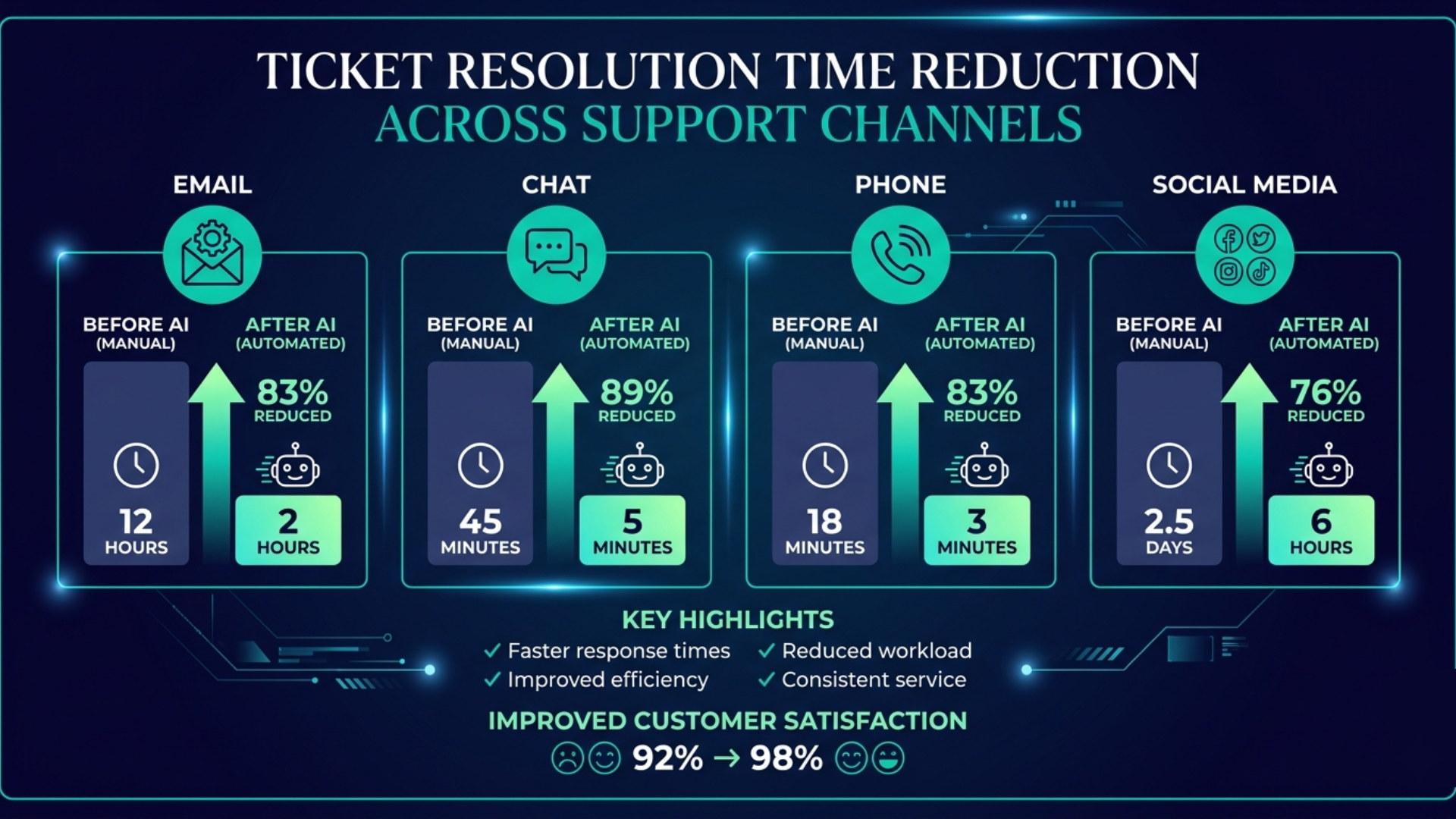
The Results: Organizations implementing this pattern typically see:
- Significant reduction in average ticket resolution time — processes that took 24–48 hours typically compress to 4–12 hours
- Lower support costs per resolved ticket — automation handles high-volume routine work, allowing human agents to focus on higher-value interactions
- Improved customer satisfaction ratings — faster resolution and proactive outreach strengthen customer relationships
- Meaningful annual savings in support operations costs at typical organizational scales
The agent handles authentication checks, database queries, and conditional logic without human oversight. When a customer needs a refund, the agent verifies eligibility, checks policy constraints, and processes the transaction. When escalation is needed, the agent summarizes context and recommends next steps.
This is not a chatbot with better responses. This is an autonomous worker that executes decisions within defined policies.
Use Case 2: Financial Close and Reconciliation — Automating Routine Reconciliation Work
The Problem: Your month-end close process involves significant manual effort reconciling transactions, matching invoices to purchase orders, flagging discrepancies, and preparing reports. The process is error-prone. Discrepancies found weeks later belong to transactions from previous periods. Your CFO cannot close books quickly. Days are consumed by routine matching work.
How Agentic AI Changes This: Finance organizations deploying agentic close automation integrate the system with ERP, accounts receivable, accounts payable, and bank feeds. The system:
- Ingests transaction data in real-time
- Autonomously matches invoices to purchase orders, checking for quantity, price, and date alignment
- Flags exceptions using multi-criteria rules (threshold amounts, vendor anomalies, timing mismatches)
- Generates variance analysis without human input
- Prepares complete close documentation automatically
The Results: Organizations implementing this pattern typically see:
- High percentage of transactions reconciled autonomously — typically 80–95% of routine transactions process without manual intervention
- Dramatic compression of close cycle — processes that required 10–20 days typically compress to 2–5 days
- Significant reduction in reconciliation errors — exceptions are caught immediately rather than discovered weeks later during audit
- Meaningful FTE reallocation — teams shift from transaction matching to analysis and strategic finance work
The agent does not wait for human approval on routine matches. It autonomously executes decisions constrained by pre-approved rules. When a transaction falls outside parameters, the agent provides analysis and recommendation—but only human judgment makes the final call on exceptions.
The business impact: Your CFO closes books faster. Your accounting team focuses on analysis, not data entry. Your financial visibility improves significantly every month.
Use Case 3: AI Agents in Healthcare Operations — Reducing Patient Appointment No-Shows
The Problem: Healthcare organizations managing tens of thousands of outpatient appointments monthly experience double-digit no-show rates, costing hundreds of thousands annually in lost appointment capacity. Staff spend significant hours attempting to reach patients to confirm appointments, with limited success. Scheduling teams cannot reach a substantial portion of patients before their appointment time.
How Agentic AI Changes This: Healthcare organizations deploying agentic patient engagement systems integrate them with scheduling, EMR (electronic medical records), and communication channels. The system:
- Monitors appointment schedules and identifies upcoming appointments needing confirmation
- Initiates multi-channel outreach: SMS, email, IVR calls, and patient portal notifications
- Acknowledges patient confirmations and flags barriers to attendance (transportation, childcare, cost concerns)
- Offers alternative appointment times and telehealth options when barriers are identified
- Escalates high-risk cases (non-confirmed, stated barriers) to human care coordinators
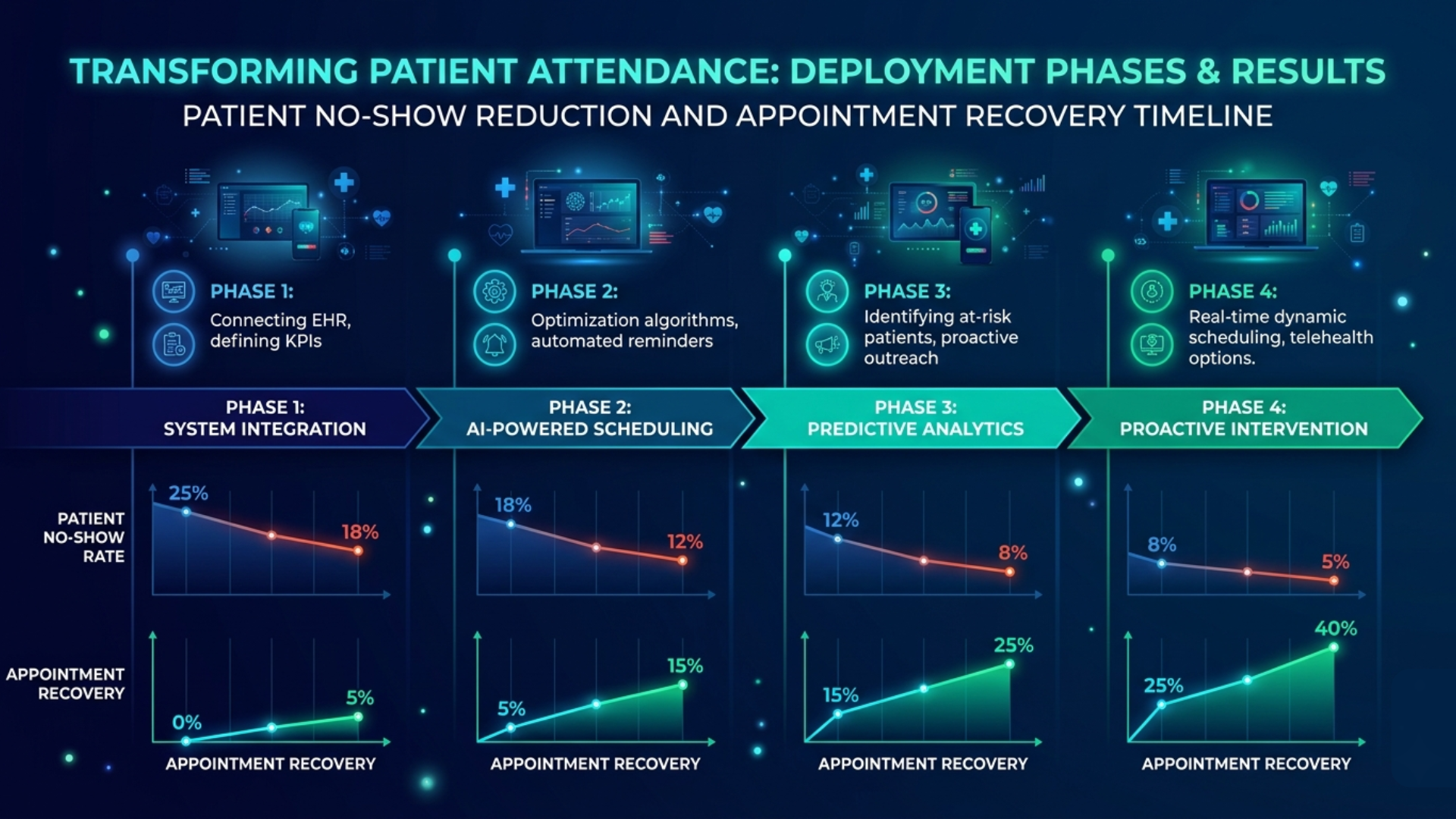
The Results: Healthcare organizations implementing this pattern typically see:
- Significant reduction in no-show rates — organizations typically see reductions of 30–50% in no-shows, depending on baseline and patient population
- Substantial recovered appointment capacity — recovered slots translate directly to revenue recovery
- Improved patient satisfaction with appointment communication and reminder systems
- Meaningful reduction in scheduling team workload — staff focus on complex logistics rather than routine confirmation calls
This system reaches the vast majority of patients before their appointment. When a patient confirms via SMS, the agent updates the schedule immediately. When a patient indicates they cannot attend, the agent offers alternatives and documents the reason. Only complex cases require human intervention.
The outcome: Your hospital operates closer to capacity. Your scheduling team focuses on complex logistics. Your revenue improves.
Use Case 4: Autonomous Agents in Software Engineering — Accelerating Deployment Velocity
The Problem: Your engineering team manages a complex microservices architecture. Deployments require orchestrating code reviews, automated tests, security scanning, infrastructure checks, and staged rollouts. A routine deployment takes 6–10 hours from merge approval to production. Your deployment frequency is constrained by process, not capability. Your competitors are deploying multiple times daily. You deploy twice weekly.
How Agentic AI Changes This: Software organizations deploying agentic AI for deployment orchestration integrate the system with code repositories, CI/CD pipelines, and monitoring infrastructure. The system:
- Monitors code repository for approved pull requests
- Autonomously executes test suites, security scans, and dependency checks
- Provides risk assessment based on code changes, test coverage, and deployment history
- Stages deployments to canary environments and monitors for anomalies
- Promotes to production when risk metrics pass pre-defined thresholds
- Rolls back automatically if error rates exceed baseline within defined time windows of deployment
The Results: Software organizations implementing this pattern typically see:
- Significant reduction in deployment cycle time — typical compression is 40–60%, taking hours off deployment duration
- Dramatic increase in deployment frequency — teams move from weekly/twice-weekly deployments to daily or multiple-times-daily
- Reduction in deployment-related incidents — automation removes many error categories associated with human gatekeeping
- Meaningful business value from accelerated feature time-to-market
This agent does not ask for permission on routine deployments. It executes within guardrails. When deployment risk exceeds thresholds, it escalates and provides justification. Engineers focus on building, not shepherding code through approval workflows.
The strategic impact: Your product velocity increases. Your ability to respond to customer feedback improves. Your competitive advantage compounds.
Use Case 5: Compliance and Risk Monitoring — Identifying Regulatory Violations in Real-Time
The Problem: Your financial services company must monitor millions of transactions daily for AML (anti-money laundering) violations, sanctions violations, and suspicious activity patterns. Your compliance team manually reviews flagged transactions—hundreds or thousands weekly. False positives waste time. True positives are occasionally missed. Your risk appetite is high because you cannot afford to process every transaction with human review.
How Agentic AI Changes This: Financial services organizations deploying agentic compliance systems integrate them with transaction processing, customer databases, and regulatory data feeds. The system:
- Processes 100% of transactions in real-time against regulatory rulesets
- Autonomously evaluates transactions against AML/KYC (know-your-customer) rules
- Flags high-confidence violations immediately, triggering case creation
- Performs contextual analysis on flagged transactions (customer history, behavior patterns, geography)
- Routes only ambiguous cases to compliance officers with full analytical context
- Submits SARs (suspicious activity reports) when confidence thresholds are met
The Results: Financial services organizations implementing this pattern typically see:
- Faster violation identification — real-time detection catches violations immediately rather than through periodic manual review
- Significant reduction in false-positive escalations — multi-stage contextual filtering reduces noise reaching compliance teams
- Improved detection of genuine violations — autonomous systems identify patterns at scale that humans would miss
- Meaningful annual savings in compliance staff time and reduced regulatory remediation costs
This system makes autonomous decisions on low-risk transactions. When a customer’s behavior deviates from baseline, the system flags it immediately with analysis. When regulatory thresholds are crossed, the system escalates and documents reasoning. Your compliance team shifts from reactive review to proactive investigation of genuine risk.
The regulatory impact: You maintain tighter control over risk. Your audit results improve. Your regulatory relationship strengthens.
Use Case 6: Enterprise Data Analytics and Insights — Automating Report Generation and Analysis
The Problem: Your analytics team spends 50–60% of capacity on routine reporting: weekly dashboard updates, monthly performance summaries, ad-hoc executive queries. Your CFO asks “What drove the revenue variance?” and waits 24–48 hours for analysis. Your team cannot keep pace with analytical requests. Strategic analysis waits while teams process routine reports.
How Agentic AI Changes This: Enterprise organizations deploying agentic analytics systems integrate them with data warehouses, BI platforms, and business systems. The system:
- Monitors key business metrics and automatically detects anomalies
- Generates hypothesis-driven analysis when variance is detected
- Queries data warehouses, runs statistical tests, and surfaces insights
- Composes executive-ready reports with findings, context, and implications
- Escalates novel patterns that require domain expertise to human analysts
- Learns continuously from analyst feedback, refining analysis quality
The Results: Enterprise organizations implementing this pattern typically see:
- Significant reduction in routine reporting workload — frees 40–60% of analyst capacity for strategic work
- Dramatic acceleration of analytical turnaround — queries answered in hours instead of days
- Improved insight discovery — system identifies patterns and correlations at scale that human analysts would miss
- Meaningful business value from accelerated decision-making and faster market insights
Your CFO now receives variance analysis within 2–4 hours instead of 24–48 hours. Your team identifies business opportunities hours before they would have surfaced through manual analysis. Your competitive response improves.
Use Case 7: Generative AI Use Cases in Content Operations — Reducing Production Cycle Time
The Problem: Your marketing team produces substantial volumes of content monthly—blog posts, case studies, whitepapers, email campaigns, social content. Content creation is bottlenecked on subject-matter experts and copyeditors. Your production cycle is 4–8 weeks from brief to published. Your competitors publish weekly. You publish monthly.
How Agentic AI Changes This: Marketing organizations deploying agentic content operations integrate them with content management systems, brand guidelines, and analytical tools. The system:
- Ingests content briefs and research inputs (client data, case study interviews, performance metrics)
- Autonomously generates first-draft content aligned to brand voice and SEO requirements
- Conducts fact-checking against approved sources and flags unsourced claims
- Optimizes for target keywords and readability without keyword stuffing
- Routes to human editors for final review and approval
- Publishes to web, email, social, and tracking systems upon approval
The Results: Marketing organizations implementing this pattern typically see:
- Significant reduction in content production cycle — 50–70% compression in time from brief to publication
- Meaningful increase in content velocity — 2–3x increase in published pieces without proportional headcount growth
- Consistent brand voice across all content (enforced by agentic AI style guides and templates)
- Meaningful annual savings in freelance content and outsourcing costs
Your human editors now work on strategic positioning and brand differentiation, not structural editing. Your content volume increases without proportional headcount growth. Your SEO visibility and market penetration improve.
Use Case 8: Supply Chain and Logistics Optimization — Reducing Fulfillment Delays
The Problem: Your e-commerce operation fulfills tens of thousands of orders daily across multiple warehouse locations. Your logistics team manually allocates orders to warehouses based on inventory position and shipping proximity. This process introduces delays (2–4 hours between order receipt and warehouse allocation). Stock-outs occur because inventory data is not updated in real-time. Fulfillment delays cascade throughout the network.
How Agentic AI Changes This: E-commerce organizations deploying agentic fulfillment orchestration integrate the system with inventory management, warehouse systems, and carrier platforms. The system:
- Receives orders in real-time and evaluates warehouse inventory across all locations
- Autonomously allocates orders to optimize shipping speed, cost, and inventory balance
- Monitors inventory levels and triggers replenishment orders when thresholds are approached
- Re-routes orders dynamically when preferred warehouse is nearing stock-out
- Coordinates logistics with carrier systems to schedule pickups and optimize routes
- Escalates only exceptions (back-orders, damaged inventory, carrier unavailability) to human operators
The Results: E-commerce organizations implementing this pattern typically see:
- Significant reduction in order-to-fulfillment delay — 40–60% compression in allocation time
- Meaningful improvement in fulfillment cost-per-order through optimized allocation and routing
- High on-time delivery rates — eliminating human allocation errors improves consistency
- Meaningful annual savings in expedited shipping and inventory carrying costs
Your fulfillment team now focuses on exception handling and customer escalations. Your order velocity increases. Your customer satisfaction and retention improve because orders ship faster.
Use Case 9: AI Agents in Enterprise Risk and Fraud Detection — Preventing Significant Annual Losses
The Problem: Your insurance, financial services, or healthcare organization processes tens of thousands of claims or transactions monthly. Your fraud investigation team manually reviews high-risk cases, consuming significant hours weekly. Your fraud detection rate is below industry benchmarks. Your competitors using autonomous agents are catching fraud at substantially higher rates.
How Agentic AI Changes This: Risk-sensitive organizations deploying agentic fraud detection integrate them with claims systems, external data feeds, and case management tools. The system:
- Analyzes every claim application and history against hundreds of fraud indicators
- Identifies suspicious patterns: inconsistent documentation, behavioral anomalies, network connections to known fraud rings
- Autonomously validates evidence and generates investigation recommendations
- Coordinates with external databases (public records, law enforcement databases, medical records) to corroborate findings
- Flags high-confidence fraud for immediate claim denial with justification
- Routes medium-confidence cases to human investigators with complete analytical support
The Results: Risk-sensitive organizations implementing this pattern typically see:
- Meaningful improvement in fraud detection rates — organizations report 2–4x improvements in fraud identification
- Substantial annual savings in prevented fraudulent payouts
- Significant reduction in investigator workload per case reviewed
- High accuracy rate on fraud verdicts (false-positive denials reduced significantly)
Your investigators now review only cases where AI confidence is borderline. High-confidence fraud is caught immediately. Your loss ratio improves. Your profitability improves.
Key Success Metrics — What to Track Before Your Next Deployment
Agentic AI delivers measurable ROI, but only if you measure against the right metrics. Before deploying an autonomous agent system, establish baselines for:
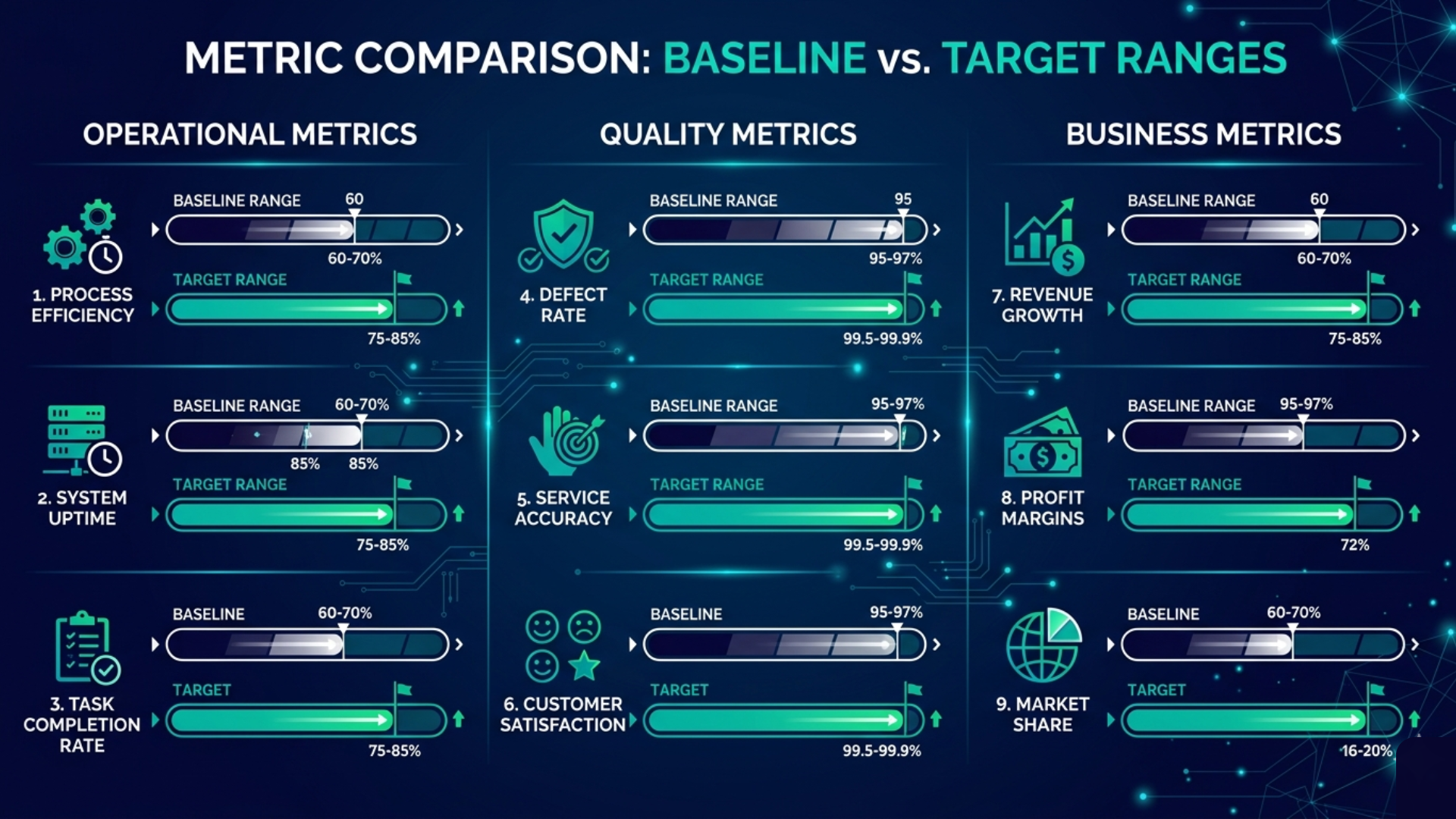
Operational Metrics:
- Process cycle time (before and after autonomous agent deployment)
- Error rate per transaction or process step
- Headcount required to process volume
- Cost per transaction or unit processed
Quality Metrics:
- Accuracy on autonomous decisions (correct vs. incorrect outcomes)
- Escalation rate (% of cases requiring human review)
- False-positive rate (cases autonomously escalated that did not require escalation)
- Customer satisfaction or stakeholder satisfaction with outcomes
Business Metrics:
- Revenue impact from accelerated decisions or faster time-to-market
- Cost savings from FTE reduction or process compression
- Risk reduction from eliminated manual errors
- Competitive response time improvement
The organizations implementing agentic AI measure all three categories. They do not deploy for feature parity. They deploy to compress cost, accelerate decisions, or improve quality. And they measure relentlessly.
If you cannot articulate the baseline and target metrics before deployment, you will not know if your agentic AI system is delivering value.
Common Pitfalls and How Leading Organizations Avoid Them
Pitfall 1: Deploying Agents Without Clear Governance
Problem: Agentic AI systems make autonomous decisions. Without guardrails, those decisions can violate policy, expose risk, or create liability.
Solution: Define decision boundaries upfront. What can the agent decide independently? What requires escalation? What data sources is the agent allowed to access? Which systems can it modify? Leading companies document this in a decision policy before deployment.
Pitfall 2: Measuring Only Velocity, Not Quality
Problem: Your agent processes 10x volume, but escalation rate climbs to 40%. You have not improved efficiency; you have created a bottleneck.
Solution: Establish quality baselines before deployment. Track escalation rate, accuracy, and false-positive rate continuously. If any metric deteriorates, pause deployment and recalibrate.
Pitfall 3: Treating Agents as “Set and Forget”
Problem: You deploy an agentic AI system and assume it operates in steady-state. Market conditions change. Fraud patterns evolve. The agent’s performance degrades.
Solution: Implement continuous monitoring and retraining. The best-performing agents are retrained monthly, incorporating new data, updated rules, and human feedback from escalated cases.
Pitfall 4: Deploying Without Change Management
Problem: Your team views the agentic AI system as replacing them. Adoption stalls. The system processes only 30% of potential volume because your team circumvents it.
Solution: Position the agent as a co-worker that removes toil. Show your team that their role is evolving—from transaction processing to judgment calls, from data entry to analysis. Organizations succeeding with agentic AI position agents as multipliers, not replacers.
Ready to Assess Your Organization’s Agentic AI Potential?
The gap between understanding agentic AI and implementing it successfully is exactly where your competitors are gaining ground. Every quarter you defer is a quarter where autonomous agents in your competitor’s organization are compressing costs, accelerating decisions, and improving quality while your teams remain constrained by manual processes.
This is not a “nice-to-have” technology. This is now operational necessity.
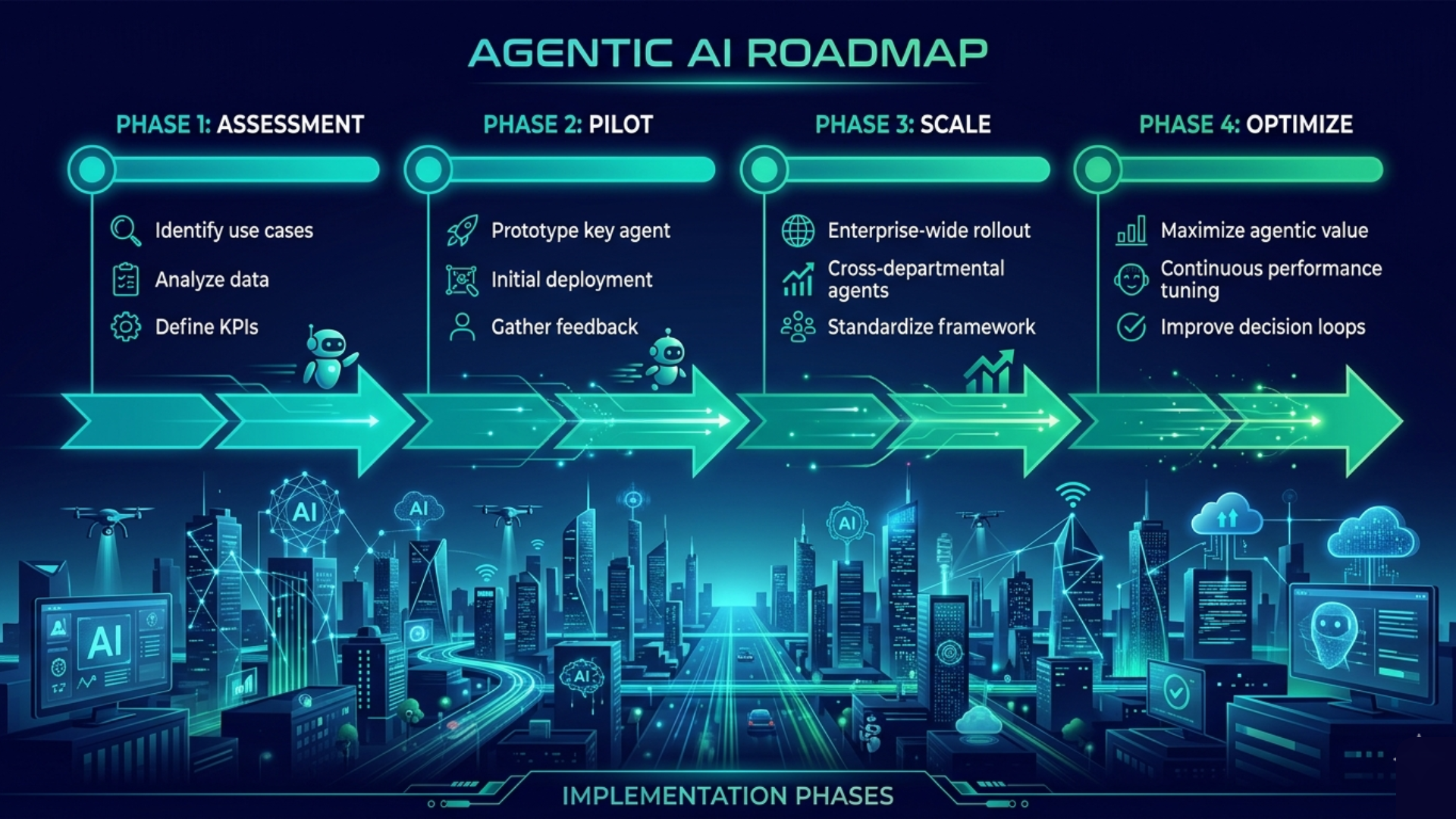
Agentic AI is moving from pilot to production at companies in your industry. Your question is not whether to explore it, but how quickly you can assess your organization’s readiness and identify the highest-ROI deployment opportunity.
Start here: Take our 10-question Agentic AI Readiness Assessment and get a personalized scorecard that benchmarks your organization against industry maturity leaders in your sector. Understand where you lead, where you lag, and which use case offers the fastest path to your first autonomous agent deployment.
Take the assessment. Learn where you stand. Then act.